

Sagging Breasts: Causes and Treatments
Ankara Aesthetics Clinic
What to know about sagging breasts
Sagging breasts can develop over time due to factors like ageing, pregnancy, weight changes, and gravity, but modern aesthetic treatments offer effective ways to restore a firmer, more youthful appearance.
What is breast sagging?
Breast sagging, medically known as ptosis, is a natural condition where the breasts lose firmness and begin to droop over time. It commonly occurs due to ageing, pregnancy, breastfeeding, weight changes, and gravity, as the skin and supportive tissues gradually lose elasticity. While completely normal, breast sagging can affect body confidence, and many people choose cosmetic solutions such as a breast lift to restore a firmer, more youthful shape.
Why do breasts sag?
Large breasts sag more quickly due to their weight and gravity, and sagging can be observed even in adolescence. Some of the factors that can cause sagging breasts are:
- Smoking,
- Obesity,
- Pregnancy,
- Breastfeeding,
- Ageing,
- Wrong exercise,
- Genetic factors,
- The effect of gravity,
- Hormonal causes,
- Gaining and losing excess weight,
- Structure of breast tissue,
- Overburdening of the breasts,
- Congenital weakness of the ligaments carrying the breast,
- Some environmental reasons, such as excessive sun exposure,
- Reduction and relaxation of breast tissue due to menopause,
- Silicone implants are applied for breast augmentation.
What are the types of breast sagging?
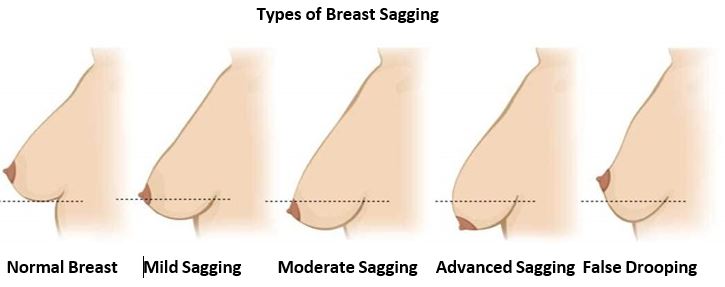
The downward displacement of the nipple and its surrounding pink-brown area (nipple-areola) relative to the breast fold line is called “breast sagging”.
In the normal breast, the nipple is above the breast fold line. The lower pole of the breast (the part between the nipple and the inframammary fold) is slightly curved outward. However, it is not very loose and saggy. The relationship of the nipple with the breast fold line and the lower pole of the breast shows the degree of breast sagging.
1st-degree sagging (mild sagging): The nipple is at the level of the breast fold line or just 1 cm below it. It is above the lower pole, and pointing opposite.
2nd-degree sagging (moderate sagging): The nipple is 1-3 cm below the breast fold line. Part of the lower pole of the udder is located below the nipple, and the nipple points slightly down.
3rd-degree sagging (advanced sagging): The nipple is more than 3 cm below the breast fold line. The nipple is at the lowest point and points down. In other words, the lower pole of the breast remained above the nipple.
4. False drooping (pseudoptosis): The nipple is above the breast fold line, but the lower pole of the breast is drooping and below the breast fold line.
What should be done for breast sagging?
After the situation is diagnosed, a proper clinical evaluation by a qualified plastic surgeon is essential to determine the most appropriate treatment option.
Non-Surgical Treatments:
Non-surgical methods may help in very mild sagging, but they do not provide permanent or significant lifting:
- Supportive bras to improve daily comfort and appearance
- Posture correction and chest muscle strengthening exercises
- Skin-tightening treatments (radiofrequency, ultrasound-based devices)
These treatments can improve skin quality but cannot lift sagging breast tissue.
For moderate to advanced breast sagging, surgical intervention is the only reliable and long-lasting option:
Is it possible to correct breast sagging with only implants?
Fast and Effective Solution in Breast Aesthetics: Reshape with a Single Procedure.
If the breast deformity is not severe, a breast lift can be achieved with just a small incision and silicone implants. This method is an effective solution, especially for mild sagging, providing a firmer and more lifted appearance without the need for more extensive surgical procedures.
Breast Lift (Mastopexy):
Breast lift removes excess skin, reshapes the breast tissue, and repositions the nipple to achieve a firmer, more youthful breast contour.
Breast Lift with Implants:
Recommended when sagging is combined with volume loss. Implants restore fullness, while the lift corrects drooping.
Breast Reduction:
Breast reduction is suitable for patients with large, heavy breasts where excess weight contributes to sagging and physical discomfort.
Does breast reduction surgery help keep the breasts upright?
Breast reduction surgery not only reduces the size but also enhances the appearance, making the breasts appear more lifted and youthful. But does it really help with that natural, firm look? The answer is on video.
While mild breast sagging may benefit slightly from non-surgical measures, breast lift surgery is a permanent treatment for achieving a noticeable, safe, and long-term correction. A personalised consultation with a board-certified plastic surgeon is essential to choose the most suitable approach and achieve natural-looking results.
At what point do you need a breast lift?
- In those with breast disproportion,
- Those with breast-hip disproportion,
- Those who want to reduce breast size or sagging after pregnancy,
- All women over the age of 18 who are physically and mentally healthy,
- Those who have sagging breasts due to breastfeeding,
- Due to gravity, those with sagging breasts,
- People who are not satisfied with the appearance or size of their breasts,
- In individuals whose breast structure is small from birth and who are uncomfortable with their shape due to sagging,
- In individuals with nipples and nipples turned down,
- To recover sagging breasts due to too much weight gain and loss,
- If the breasts have a flatter and longer shape,
- When the breasts sag and lose volume,
- After irregular bra use,
- In case of loosening of your skin and nipple,
- If one breast is lower than the other and drooping,
- In the case of sagging breasts due to trauma,
- Without a bra, in cases where the breast tissue is under the breast fold area,
- When there is loosening on the nipple and your skin,
In these cases, a breast lift operation is performed.
What are the breast lift surgery methods?
Breast lift surgery aims to move the sagging nipple to where it should be, remove excess breast skin, and give the breast a more aesthetic shape.
Different techniques are used according to the degree of deformation in the breast. Depending on the methods applied to the breast skin, some scars remain. There may be scars not only on the nipple but also under the breast (lollipop, vertical, inverted T). The figure showing the scars of breast lift surgery is below.
How is breast lift surgery done?
There are different ways to do breast lift surgery:
- In smaller breasts, sagging may be present along with a lack of volume. In these situations, a silicone breast implant can be put in to make the breast look fuller and higher at the same time.
- For women with bigger or heavier breasts, extra breast tissue and skin are taken away to make them lighter and give them a more balanced, higher contour.
After the breast tissue has been reshaped, the extra skin is cut away, and the nipple-areola complex is moved to a higher, more natural position. After the surgery, the incision is carefully closed to promote healing and improve the quality of the scar.
Methods based on how much the breasts are sagging
Mild Breast Sagging (Grade I)
A crescent-shaped skin excision may be done along the upper edge of the areola in the early stages of sagging. This lets you lift the nipple a little bit with little scarring.
Moderate Breast Sagging (Grade II)
To make the sagging more noticeable, skin is taken off around the areola to make it smaller and raise the nipple. This method only leaves scar around the edge of the areola. The skin around the nipple may temporarily wrinkle or pucker, but this usually goes away on its own. A vertical lift technique can be used to make the contour smoother. In this case, the incision goes down from the areola, leaving a vertical scar that gives stronger reshaping.
Severe Breast Sagging (Grade III)
The inverted T (anchor) technique is used for advanced sagging. This technique involves making a vertical cut and a horizontal cut that is hidden in the fold of the breast. It does leave more scars, but it gives you better reshaping, making your breasts rounder, more projected, and conical.
Pseudoptosis (False Breast Sagging)
In pseudoptosis, the nipple stays in a normal position, but the bottom of the breast looks droopy. You can choose from these options to fix it:
- Breast implants, which add volume and lift the lower breast with little scarring
- A "vertical lift technique" to reposition the nipple and change the shape of the lower pole in a subtle way.
In these cases, implants are often the best choice because they fix the look with fewer visible scars.
A thorough consultation is necessary to find the best method and to make sure that both the surgery and the look are safe.
Breast lift surgery is a highly customizable procedure. When planned and performed by an experienced plastic surgeon, it delivers natural-looking, long-lasting results tailored to the patient’s anatomy and expectations.
Please contact us for detailed information or to schedule a consultation at Gozde Erten Aesthetics Clinic.