

CO₂ fractional laser offers a modern, safe and effective solution for skin rejuvenation (anti-ageing), acne scars, stretch marks and blemish treatment. This method, applied with personalised protocols under the supervision of a specialist physician, stands out for its short recovery times, high patient satisfaction, and long-term results. Thanks to this treatment, patients gain significant improvements in both their aesthetic appearance and self-confidence. In this article, you'll find all the details you may be curious about, including the treatment process, session intervals, factors affecting prices, recovery stages and points to consider.
What is fractional CO₂ laser treatment?
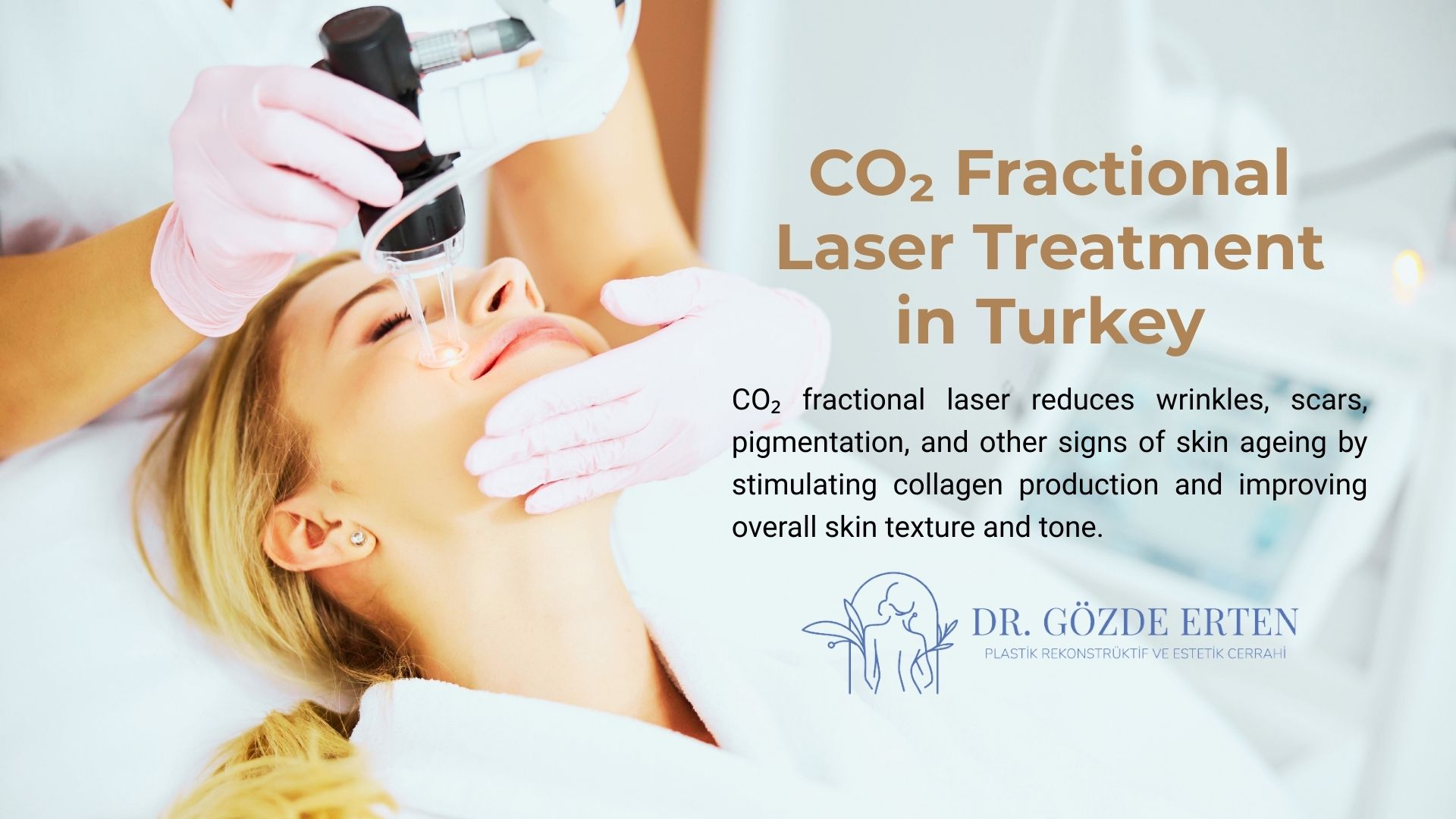
Fractional CO₂ laser is an advanced treatment method that stands out in aesthetic dermatology for skin renewal and repair. It works by creating controlled micro-damage to activate the skin's natural healing mechanism. Fractional carbon dioxide laser treatments performed in Turkey, Ankara, in particular, provide both safe and effective results thanks to state-of-the-art devices and experienced specialist physicians.
This method creates laser in the form of microscopic columns (microchannels) on the skin's surface, promoting the renewal of damaged tissues and increasing collagen production. Thus, it can target many skin problems, such as wrinkles, blemishes, acne scars, stretch marks, and sagging. Most clinics in Turkey, Ankara offer personalised treatment plans using FDA-approved, state-of-the-art devices, ensuring the highest level of treatment quality and patient satisfaction.
For expert and reliable experience in skin rejuvenation and aesthetic solutions with fractional laser (CO₂ laser) in Turkey, Ankara, please contact us. We await you to reveal your healthy and natural beauty with your personalised treatment plans.
Benefits of getting fractional CO₂ laser in Turkey, Ankara
- The availability of modern clinics equipped with high-tech facilities
- The provision of services by specialist plastic surgeons and dermatologists
- The implementation of personalised, precise treatment protocols
- Procedure safety and the long-term durability of effective results
For these reasons, it offers a compelling option for those seeking fractional laser treatment in Turkey, Ankara.
How does fractional CO₂ laser work?
The basis of fractional laser technology lies in the application of laser light onto the skin in the form of thousands of microscopic columns (micro-holes). In particular, the fractional carbon dioxide (CO₂) laser operates at a wavelength of 10,600 nm, creating microthermal zones in the skin. The controlled damage in these zones triggers new collagen and elastin production in the deeper layers of the skin. Thanks to the fractional (segmented) application of the laser, both damaged and intact tissue are left in the skin; the intact tissue accelerates the healing process and reduces the risk of side effects.
The difference between the CO₂ laser and classic ablative lasers is that it creates micro-damage only at specific points rather than removing the entire skin. This shortens the healing time and minimises the risk of complications. The fractional CO₂ laser targets water molecules in the skin, causing selective thermal damage to water-containing structures such as collagen, keratinocytes, and blood vessels. The healthy cells surrounding the damaged areas initiate the repair process and promote the formation of new tissue.
Where can CO₂ laser be used?
Fractional CO₂ laser has an expansive range of applications for skin problems. The most common areas of application are as follows:
- Wrinkles and fine lines: it reduces the appearance of lines caused by ageing, sun damage and environmental factors.
- Acne and acne scars: it reduces the depth of atrophic scars and smooths skin texture.
- Skin spots and pigmentation disorders: it provides tone uniformity in pigment problems such as sun spots, age spots, and melasma.
- Stretch marks (striae): it reduces the appearance of stretch marks caused by pregnancy, weight change, or puberty.
- Scars and surgical marks: it softens the texture of scars caused by surgery, burns, trauma, or cuts and make their colour match the surrounding tissue.
- Sagging skin and loss of elasticity: it restores skin firmness and elasticity by increasing collagen production.
- Enlarged pores: it reduces pore size, improves skin texture, and tightens the skin.
Clinical observations and patient reviews indicate that fractional laser has a high success rate, particularly for acne scars, stretch marks, and signs of ageing and provides a skin rejuvenation (anti-aging) effect.
How is fractional laser treatment performed?
A CO₂ fractional laser treatment is performed using a patient-focused and personalised protocol. At our centre in Ankara, the process typically consists of the following steps:
- Examination and skin analysis: Prior to treatment, a detailed skin analysis is performed by Aesthetic Surgery Specialist Op. Dr Gözde Erten. Skin type, depth of problems, patient expectations and any contraindications are evaluated. At this stage, we also consider the patient's medications, previous skin treatments, and overall health status.
- Preparation and anaesthesia: On the day of the procedure, the treatment area is disinfected with professional cleaning solutions. Make-up, oil and dirt on the skin are all completely removed. Then, a topical anaesthetic cream is applied to increase the patient's comfort. This cream is usually left on for 30-45 minutes and minimises pain during the procedure.
- Fractional laser application: The fractional laser device works by creating controlled micro-channels (microscopic holes) in the skin. Each laser pulse reaches specific depths in the skin and triggers tissue renewal. During the application, the device head is systematically moved over the area to be treated. The same area can be treated multiple times using a criss-cross technique. The duration of the procedure varies depending on the size of the area being treated; a full-face application usually takes 20-40 minutes.
- Cooling and skin protection: Mild redness and swelling may occur on the skin after the procedure. A cooling gel or mask is applied to soothe the skin during this period. Additionally, skincare is supported by moisturisers and restorative creams. In some cases, antibiotic cream or antiviral medication may be prescribed (especially for those with a history of cold sores).
How many sessions of CO₂ fractional laser are needed?
Fractional laser treatment is not usually completed in a single session; multiple sessions are recommended for ideal results. Although an individual assessment is required, the number of fractional laser sessions and intervals are generally as follows:
|
Skin Diseases |
Number of Sessions |
Session Intervals |
|
Mild sunspots |
2-3 |
4-6 weeks |
|
Deep acne scars |
4-6 |
6-8 weeks |
|
Fine lines |
3-4 |
4-5 weeks |
|
Noticeable wrinkles |
5-7 |
6-8 weeks |
|
Pore width |
3-5 |
4-6 weeks |
Treatment results may vary depending on the individual, skin type, and device parameters used. This table only shows general application ranges.
The number of sessions for fractional laser treatment is personalised according to the patient's skin type, the depth of the problem, and their expectations. Typically, 3-6 sessions are performed, with 4-8 weeks between sessions. This interval is critical for the collagen production process to be completed.
Co₂ fractional laser treatment cost in Turkey, Ankara
Fractional laser (CO₂) prices in Ankara vary depending on many factors, such as the technological equipment of the centre where the procedure will be performed, the doctor's experience, the scope of the treatment plan, and the size of the treatment area.
The main factors affecting fractional laser prices are:
- The size of the treatment area (e.g., only around the eyes or the entire face)
- The technology of the device used
- The number of sessions and intervals in the treatment
- The location and service quality of the centre
- The physician's experience and clinical equipment
- Combination treatments (additional applications such as PRP, mesotherapy, fillers, under-eye light fillers, radiofrequency, and fat injections)
Fractional laser prices are generally determined per session, and package programmes can lower the unit session price. Detailed pricing information requires a preliminary examination and a customised treatment plan. For more detailed information, please consult Plastic, Reconstructive and Aesthetic Surgery Specialist Op. Dr Gözde Erten's Clinic, which offers professional services in fractional carbon dioxide (CO₂) laser treatments. Please contact us to make an appointment.
What to do after fractional CO₂ laser treatment
The recovery process following fractional laser treatment varies depending on the depth of the application, skin type, and the area treated. Typical recovery stages are as follows:
- First 24-48 hours: The skin experiences intense redness, warmth, and slight swelling. It may feel similar to a sunburn. Cold compresses and soothing creams are recommended.
- Days 2-4: Redness persists, and the skin feels tight with slight scabbing. Swelling subsides. Scabs should not be picked off, and the skin should not be peeled.
- 5-7 days: Scaling is complete, and fresher skin appears underneath. A slight pinkness may remain. Makeup can be applied.
- 7-10 days: The skin largely recovers. It may take several weeks to see the full results. As collagen production continues, the skin tightening and renewal process continues for several months.
Things to consider during the recovery process:
- Sunscreen (SPF 50+) must be used.
- Scabs should not be picked at and the skin should not be peeled.
- No cosmetics other than those recommended by the doctor should be used.
- Activities involving excessive heat exposure, such as saunas, steam rooms and strenuous exercise, should be avoided for 1 week.
- Makeup should not be applied in the first few days; light makeup should be preferred once the skin has fully recovered.
Returning to social life after fractional laser (CO2) treatment is generally possible within 3-7 days. This period may be longer for deeper applications. The vast majority of patients can return to work and social life within a week.
What are the side effects and risks of fractional laser treatment?
When experienced specialists perform fractional laser treatments using the correct protocols, they are considered quite safe. However, like any invasive procedure, they carry certain side effects and risks:
- Temporary redness and swelling: This may last for the first 2-7 days after the procedure. It may be particularly noticeable in sensitive areas such as around the eyes.
- Scabbing and peeling: This resolves spontaneously within 3-7 days. Picking at scabs increases the risk of scarring.
- Pigmentation changes: Individuals with darker skin tones are at risk of hyperpigmentation or hypopigmentation. Sun protection reduces this risk.
- Infection: A bacterial or viral infection may develop if proper sterilisation is not ensured. Herpes activation may occur, especially in those with a history of cold sores; antiviral treatment may be initiated prior to the procedure.
- Scarring: Incorrect parameter selection or repeated applications may cause atrophic or hypertrophic scars. Caution is advised in those with a history of keloids.
- Acne flare-ups: acne-like eruptions may occur, particularly after the use of intensive moisturisers.
To minimise the risk of side effects, pre- and post-procedure instructions must be followed thoroughly, sun protection and moisture support should be provided, and skin care should be performed with diligence.
Who should not get a CO2 laser?
Fractional laser treatment can be safely performed on many patients who do not have serious health problems. However, it should not be performed in the following cases:
- Pregnancy and breastfeeding
- Use of isotretinoin (Roaccutane) within the last 6 months
- Active skin infection or cold sore (herpes simplex)
- History of keloid or hypertrophic scarring
- Bleeding disorders or use of anticoagulant medication
- Skin cancer or serious dermatological diseases
- Open wounds or active acne on the skin
A detailed assessment must be carried out by a specialist physician prior to treatment, and a personal risk analysis must be performed.
Treatments that can be combined with fractional laser
Fractional laser is a powerful skin rejuvenation method on its own, but its effects can be significantly enhanced in certain cases through combined protocols. The following combinations are frequently used in centres in Turkey, Ankara:
- Fractional Laser + PRP (Platelet Rich Plasma): When applied after laser treatment, PRP shortens the recovery time and boosts collagen production.
- Fractional Laser + Mesotherapy: Mesotherapy ingredients are absorbed more effectively through the micro-channels created by the laser; preferred for individuals with moisture loss, dull appearance, or reduced elasticity.
- Fractional Laser + Filler: In areas with deep volume loss, filler application after laser treatment provides rejuvenation of both surface and deep tissues.
- Fractional Laser + Radiofrequency (RF) Microneedling: Provides dual collagen stimulation in deep acne scars, burns, or surgical scars; RF energy heats the dermal layer to create a tightening effect, while the laser renews the surface tissue.
Combination treatments shorten recovery time, increase the longevity of the effect, and deliver more noticeable results with fewer sessions.
How long after fractional laser will I see results? & How long does the laser effect last?
The effects of fractional laser treatment typically begin to appear within 1-2 weeks; the skin becomes brighter, more vibrant, and smoother. The main noticeable change, however, becomes clearer within 4-8 weeks as collagen production increases, and for many people, results continue to improve gradually over 2-3 months.
Longevity varies depending on skin type, age, lifestyle, sun exposure, skincare routine, and the number of sessions performed. Increased collagen can provide long-term benefits, but as the skin continues to age and be exposed to environmental factors, regular sun protection, proper skincare, and maintenance sessions may be recommended for some individuals to preserve the results.
Fractional CO2 laser treatment reviews
The experiences of patients who have undergone fractional laser treatment provide an important reference in terms of the treatment's effectiveness and satisfaction levels. Patients who have undergone the procedure at centres in Ankara, in particular, highlight the following common points:
- Detailed information and personalised planning prior to treatment increase satisfaction.
- Although there is a slight discomfort during the procedure, anaesthetic creams ensure that pain is kept to a minimum.
- Redness and scabbing occur in the first few days after treatment; adhering to the doctor's recommended care protocol during this period accelerates healing.
- A noticeable reduction in stretch marks, acne scars and blemishes, as well as a more even skin tone, is observed.
- The vast majority of patients are able to return to their social lives shortly after the procedure and are satisfied with the results.
Some forums and complaint platforms also feature the opinions of patients who did not achieve the expected results or experienced side effects; therefore, realistic expectations and choosing a specialist physician are of critical importance.
Op. Dr Gözde Erten offers safe fractional carbon dioxide laser treatment.
Op. Dr Gözde Erten, with her extensive experience in the field of Plastic, Reconstructive and Aesthetic Surgery in Ankara, provides her patients with a holistic aesthetic approach within scientific and ethical boundaries. At her clinic, surgical and non-surgical aesthetic procedures, including fractional laser treatment, are performed with high hygiene standards and state-of-the-art technological infrastructure. Each patient receives a personalised treatment plan from Op. Dr Gözde Erten, with the goal of achieving natural and lasting results through minimally invasive methods.
Patient safety, satisfaction, and accurate information are among the clinic's core principles. All patient questions are answered before and after treatment, and care protocols are meticulously implemented. If you wish to undergo fractional CO2 laser treatment in Ankara, Turkey, please contact us.
Frequently Asked Questions
Fractional laser is a laser treatment method that creates controlled damage in the form of microscopic channels in the skin, triggering the skin's natural healing mechanism and collagen production. The CO2 laser targets water molecules in the skin and promotes renewal in both the superficial and deep layers.
It is effective for many skin problems, such as wrinkles, acne scars, blemishes, stretch marks, sagging skin, enlarged pores, wounds and surgical scars.
In the early days, redness, swelling and scabbing may occur. Within 5-7 days, the scabs fall off and the skin heals. Full results appear within a few weeks to a few months. It is important to use sunscreen and moisturiser.
Pregnant women, those who have used isotretinoin in the last 6 months, those with active infection or a history of cold sores, those with a tendency to develop keloids, and those with serious dermatological conditions should not use this product.
Temporary redness, swelling, scabbing, pigmentation changes, infection and, rarely, scarring may occur. Risks are minimised with proper care and the choice of a specialist doctor.
Generally, after 5-7 days, when the skin has fully recovered, light make-up can be applied. Only moisturiser and sunscreen should be used in the first few days.
The results obtained are long-lasting; thanks to collagen production, permanent improvement is achieved in the skin. However, as the skin continues to age, regular maintenance and follow-up sessions are recommended if necessary.
The scabs usually fall off on their own within 3-7 days. Picking at the scabs increases the risk of scarring; the skin should be allowed to heal by itself.
Most patients can return to work and social life within 3-7 days. This period may be longer for deep applications.