

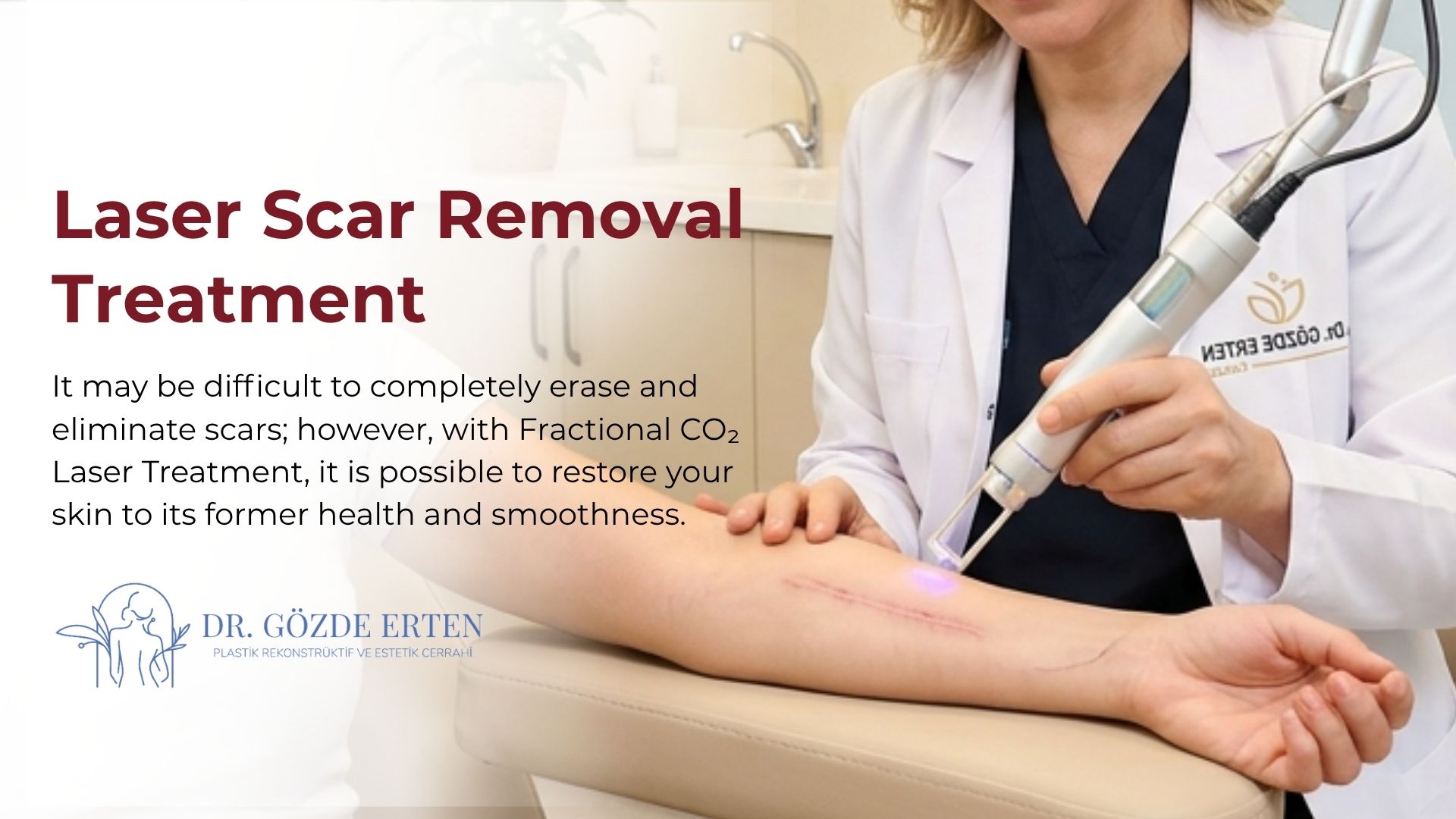
Whether caused by surgery, an unexpected accident, or the lingering marks of cuts and burns from the past... Whatever the reason, the scars on our skin are not merely a cosmetic concern; they can sometimes become a heavy burden to bear in our social lives. Among the current options for laser scar treatment, fractional CO₂ technologies stand out the most. While it is not medically possible to completely erase these scars, they aim to restore your skin to a state as close as possible to its former health and smoothness. Dr. Gözde Erten, who treats patients at her clinic in Çankaya, Ankara, customizes the procedures for laser scar removal, razor (facial) scar removal, and stitch scar removal based on how deep and structured the tissue is.
What is a scar? What causes scars?
When our skin is injured, the tissue that forms as the body repairs the damage is called a scar. However, this patch is not as perfect as our original skin; it is less elastic than normal skin, lacks hair growth, does not sweat, and contains no nerve endings.
As our body heals a wound, it actually goes through a three-stage process:
- Cleaning and protection (inflammatory phase): The injured area is cleaned and the body protects it.
- Repair (proliferative phase): New tissue is produced to close the wound.
- Remodelling: The formed tissue matures and strengthens over time.
So, why does a scar remain? Our body has one sole concern: to close the wound as quickly as possible. In this rush, rather than establishing a regular, ordered structure like that found in normal skin, it places the building blocks known as collagen in a random and disordered heap.
If the healing process becomes stalled in its early stages, the small blood vessels in the area remain visible, causing the scar to stay red. Furthermore, if some signals that start the body's healing process (like TGF-β) become too active, too much collagen is made. This causes the scar to become raised, hard and prominent on the skin’s surface; this is known as a hypertrophic scar or keloid.
How does laser treatment work for scars?
Laser scar removal and treatment are based on the principle of selective photothermolysis; that is, the laser light targets specific components in the scar tissue—such as water, haemoglobin or melanin—repairing the damaged area without harming the surrounding tissue.
- When laser beams are absorbed by the scar tissue, they encourage the body to alter the previous abnormal healing process and reorganise the tissue. This treatment method is used to reduce redness, soften the tissue and break down hardened connective tissue, thereby helping the skin to regain a more normal appearance.
- Although lasers do not eliminate scars, they can significantly improve the functionality, elasticity and aesthetic appearance of scar tissue.
- Treatment protocols typically involve several sessions, determined by the type and age of the scar, as well as the patient’s skin type.
Fractional Carbon Dioxide (CO₂) Laser Treatment
The fractional CO₂ laser targets water within the tissue at a wavelength of 10,600 nm and is one of the most effective technologies for scar treatment.
The fundamental principle of this method is based on the laser light being delivered not as a single block across the entire skin surface but divided into thousands of microscopic columns. Along these vertical columns, known as ‘microthermal zones’, the tissue is vaporised in a controlled manner, while the intact skin areas between these columns act as a reservoir of cells that accelerate healing.
It is one of the most effective methods for treating deep, raised (hypertrophic) scars and contractures that restrict joint movement.
- When laser energy penetrates the scar tissue, it breaks down the irregularly arranged collagen fibres and stimulates the body to rebuild the area with a healthier, more flexible collagen structure.
- This process not only improves the appearance of the scar but also significantly reduces symptoms such as pain, itching and tightness that impair the patient’s quality of life.
- The treatment protocol typically involves an average of 3–12 sessions, conducted at intervals of 4 to 12 weeks depending on the severity of the scar. Fractional systems can penetrate deeper than traditional CO₂ lasers, shortening the healing time and minimising the risk of infection by enhancing the skin’s natural repair capacity.
- Temporary redness, swelling and fine scabbing may occur following the procedure; keeping the skin moisturised and protecting it meticulously from the sun during this period is crucial for the success of the treatment.
Er:YAG (Erbium:YAG) and non-ablative laser systems
The Er:YAG laser (2940 nm) has the ability to ablate the skin surface in very thin layers, causing minimal thermal damage to the surrounding tissue, thanks to its very high affinity for water. With a shallower penetration depth than the CO₂ laser, the Er:YAG is particularly preferred for the resurfacing of superficial scars and in situations where thermal damage is undesirable.
- Non-ablative fractional lasers (such as 1540 or 1550 nm), on the other hand, trigger new collagen production by creating thermal damage in the deeper layers (dermis) without damaging the skin’s outermost layer.
- As these systems do not ablate the skin, recovery time is minimal and the risk of infection is lower.
- For mild to moderate scars and textural irregularities, non-ablative lasers are usually the best choice. They are also safer for people with darker skin tones.
- Both systems provide effective options for improving the texture of mature scars and enhancing the skin’s elasticity.
CO₂ or Er:YAG?
To help you make a decision, we have compared these two popular types of laser. Both use fractional technology (i.e. they cause micro-damage to only specific areas of the skin to promote rapid healing), but their power levels and applications differ.
| Feature | Fractional CO2 Laser | Fractional Er:YAG Laser |
| Treatment Strength | Very High. Considered one of the most effective options for skin resurfacing. | Moderate to High. Provides gentler skin resurfacing compared to CO2 lasers. |
| Best For | Deep wrinkles, prominent acne scars, skin laxity, and sun damage. | Moderate wrinkles, acne scars, pigmentation issues, and overall skin rejuvenation. |
| Recovery Time | Longer. Redness and crusting may last 7–10 days. Social downtime is generally greater. | Shorter. Redness usually resolves within 1–3 days, while crusting typically clears in about 4 days. Return to social activities is faster. |
| Discomfort Level | A topical anesthetic cream is usually required. Patients may experience a stronger heat sensation during treatment. | Generally less painful. In most cases, a topical anesthetic cream is sufficient. |
If you have very severe scarring and deep wrinkles, CO₂ is more effective but requires a longer recovery period. If you have milder issues or wish to keep the recovery period short, Er:YAG may be a more suitable option.
What types of scars respond best to laser?
Laser technology has now become one of the first-line treatments for a wide variety of scar types, including hypertrophic scars, keloids, atrophic scars and acne scars. By improving the colour, thickness, texture and elasticity of scar tissue, it not only enhances the aesthetic appearance but also reduces physical symptoms such as itching and pain. Although the success of the treatment varies depending on the type and age of the scar, as well as the patient’s skin type, modern laser systems enable the scar to achieve a structure closer to that of normal skin tissue. In particular, fractional carbon dioxide (CO₂) lasers are important for thinning thick tissue, while pulsed dye lasers (PDL) are effective in reducing redness in scars.
Laser scar removal and treatment
Laser treatments are highly effective in treating both fresh and old surgical scars resulting from surgical procedures. Early intervention in the post-operative period can prevent the scar from becoming raised (hypertrophic scar), while the visibility of existing scars can be significantly reduced using fractional systems. Thanks to this procedure, commonly known as laser scar removal, the colour of linear scars left after procedures such as thyroid surgery or breast aesthetics is lightened and tissue stiffness is softened. The treatment process can begin immediately after the surgical stitches are removed, or it can be scheduled months later once the scar tissue has matured.
Laser stitch scar removal
Early intervention in the treatment of scar tissue has brought about a critical paradigm shift that positively influences the wound healing process. Although our patients usually come to our clinic expecting laser scar removal, our medical objective is to prevent abnormal tissue healing (abnormal scar formation) and to reduce the scar to a level where it is almost imperceptible. Sessions conducted in the early period following suture removal ensure that the scars fully integrate with the skin.
Studies have indicated that laser sessions performed on the day the sutures are removed or within the first month following their removal are highly effective in preventing abnormal tissue healing (abnormal scar formation). Laser beams control the vascularization along the suture line, ensuring that scars are less prominent, flatter, and more harmonious with the skin. This allows patients to complete the healing process without aesthetic concerns following the operation.
Laser razor (Laceration & Cut) scar removal treatment
Scars caused by razors or similar cutting tools (razor cuts) are typically traumatic scars that lead to noticeable changes in skin texture and colour variations. In the treatment of this type of scar, systems such as non-ablative fractional lasers (1565 nm) soften the appearance of the scars by promoting regeneration in the deeper layers of the skin without damaging the outer layer.
Laser treatment for razor-cut scars breaks down the hardened connective tissue at the incision sites, improving the skin’s texture and smoothness. Although it is not always possible to completely erase these scars, they can be made to blend more seamlessly with the surrounding healthy skin, thereby reducing the sense of stigma in social life.
Laser treatment for burn scars
Burn scars are among the most challenging types of scars to treat due to the tissue hardening (contracture), itching, and functional limitations they cause. Fractional CO₂ lasers create microscopic tunnels in the burn tissue, thereby increasing the elasticity of the hardened tissue and alleviating restricted movement, particularly around joints.
Furthermore, these lasers significantly alleviate the severe itching and pain commonly associated with burns. While vascular-targeted lasers are used for the redness associated with burn scars, ablative fractional systems deliver significant results for tissue thickness and a pitted appearance.
The laser scar removal process in Ankara, Turkey
For patients in Ankara seeking scar treatment, the process involves a meticulous journey that combines surgical expertise with advanced laser technology. Dr Gözde Erten combines her surgical expertise—honed through her specialisation at Ankara Numune Training and Research Hospital and her microsurgery training at GATA—with the modern laser systems in her clinic to offer a holistic approach to aesthetics.
The laser scar removal process carried out in clinical settings in Turkey, Ankara:
Dr Gözde Erten and her holistic laser approach
- At the heart of Dr Gözde Erten’s approach lies the principle that every patient is unique and that treatment must be tailored to the individual. A graduate of Gazi University Faculty of Medicine and holder of the International Medical Tourism Accreditation Certificate, Dr Erten prioritises not only the aesthetic appearance but also the functionality of the tissue in scar treatments.
- Operating within scientific and ethical boundaries and guided by a philosophy of “naturalness and minimalism", she aims to achieve effective and lasting results using minimally invasive laser methods rather than aggressive interventions.
- The specialist closely monitors technological advancements and maintains high hygiene standards in her clinic.
The laser scar removal process
- The treatment process begins with a tailored plan based on the type and age of the scar, as well as the patient’s expectations. Laser technology works on the principle of "selective photothermolysis", ensuring that the laser light is focused solely on the target scar tissue while preserving the healthy surrounding tissue.
- During this process, Dr Erten may use different laser systems, either individually or in combination, to improve the colour, thickness and elasticity of the scar tissue.
Initial consultation and personalised treatment plan
The most critical stage of the process is the detailed pre-laser assessment. At this stage, Dr Erten determines whether the scar is hypertrophic (raised), atrophic (sunken) or keloid in nature. By analysing the scar’s colour, firmness and the patient’s symptoms (pain, itching, etc.), a treatment plan is devised to ensure the least painful procedure with the best possible outcome. The timing of the treatment is also finalised at this stage; in some cases, early intervention, starting immediately after suture removal, can yield revolutionary results in preventing the formation of pathological scars.
Technology and expertise
The laser systems used in Dr Erten’s clinical practice are tailored to the specific nature of the scar.
Dr Erten’s clinical practice favours the following systems based on the scar's nature:
- Fractional CO₂ laser: Used to soften and reshape tissue in thick, raised scars that restrict movement (contractures).
- Vascular lasers (PDL, etc.): These are preferred to reduce blood flow, thereby alleviating redness and normalising healing, particularly in newly formed, red or purple active scars.
- Combination therapies: Dr Erten may use different wavelengths in the same session to achieve the best results for complex traumatic scars. For example, a vascular laser may be combined with a fractional system to address scar redness and tissue irregularities, respectively.
Recovery and aftercare
- Procedures are usually carried out under local anaesthetic, with the patient’s comfort in mind; patients can often return to their normal lives the very next day.
- During the post-treatment period, Dr Erten and her team monitor the patient closely.
- Sessions are usually repeated at intervals of 4–8 weeks, depending on the severity of the condition.
Laser scar removal aftercare
The post-treatment period following laser scar treatment is just as critical as the treatment itself in ensuring its success and minimising potential side effects. Here are the essential considerations to keep in mind during the skin's healing phase after the procedure:
Sun protection and skincare
- Sun protection: You must protect the treated area from direct sunlight for at least 3 months. When going outdoors, you must use a sunscreen with an SPF of at least 50+; it is important to remember that creams containing titanium dioxide or zinc oxide provide higher protection. Physical barriers such as wide-brimmed hats and long-sleeved clothing should also be preferred.
- Moisturising: Until the skin’s outer layer (epithelium) has fully healed, you should apply the petroleum jelly (petrolatum) or paraffin-based moisturisers recommended by your doctor at least 3–4 times a day. This prevents the skin from drying out and accelerates healing.
- Cleaning: You may bathe with warm water and a mild soap 1–2 days after the procedure; however, you should avoid very hot water, which can irritate the skin. If the facial area has been treated, it should be gently cleansed twice a day.
Ensuring comfort during the recovery process
- Swelling and a sensation of warmth: A sunburn-like sensation of warmth and swelling is normal following the procedure. Cold compresses (ice packs or ice wrapped in a towel) may be applied for relief; however, direct contact of the ice with the skin should be avoided. For facial treatments, it is recommended to sleep with your head elevated using two pillows to reduce swelling.
- Scabbing and itching: Scabs that form during the healing process must never be picked at or peeled off; doing so may lead to the formation of new scars. You may use antihistamine medication for itching, but please consult your doctor first.
- Pain management: In cases of mild discomfort, simple painkillers such as paracetamol or ibuprofen may be used, but aspirin should be avoided.
Activities and hygiene
- Daily life: Most patients can return to work or school the day after the procedure. Sport and other physical activities can be resumed gradually, depending on how well the body copes.
- Contact with water: You should avoid entering still waters such as swimming pools, the sea, hot tubs or lakes until the skin has fully healed (re-epithelialisation), which takes approximately 2–3 days.
When should you contact the doctor?
- If you notice any signs of infection in the treated area, such as a temperature above 38.5°C, persistent pus or discharge, a foul odour, excessive swelling or increasing redness, you should consult your specialist without delay.
- In particular, patients with a history of cold sores (herpes) who have undergone procedures on the face should not skip the antiviral medication prescribed by their doctor to prevent the virus from reactivating.
Laser scar removal cost in Ankara, Turkey
Key factors affecting pricing
- Type and severity of the scar: Whether the scar is hypertrophic, atrophic, or keloid determines the type of laser to be used (CO₂, Er:YAG, PDL, etc.) and, consequently, the cost.
- Number of sessions: The treatment process typically lasts between 3 and 12 sessions, depending on the depth of the scar and the patient’s expectations; the total cost varies as the number of sessions increases.
- Size of the treatment area: The size of the area to be treated, measured in square centimeters, is a key criterion in pricing.
- Combination treatments: To achieve the best results, it may sometimes be necessary to use more than one laser system simultaneously (e.g., a vascular laser for redness and a fractional laser for tissue rejuvenation).
- Additional procedures: Additional procedures that can be performed alongside laser treatment, such as steroid injections or drug delivery (LADD), may be reflected in the total cost.
Prices for laser scar removal (surgical scars, stitches, razor (facial) cuts, and burn scar removal) in Ankara, Turkey, can be provided following a detailed consultation and skin analysis. Please contact us directly to create a personalized treatment plan with Dr. Gözde Erten.
Frequently Asked Questions About Laser Scar Removal
No laser system can completely erase a scar, surgical mark, or facial scar or restore the skin to its original, undamaged state. Although laser technology represents a revolutionary step in the treatment of scars, it may not be medically realistic to claim that it can eliminate a scar and restore the skin to its "unblemished" state prior to the injury. However, lasers significantly reduce the visibility of a scar by bringing its functionality, elasticity, color, and texture closer to that of normal skin tissue. The success of the treatment varies depending on the type and age of the scar, as well as the patient’s skin type.
Laser treatments ‘remodel’ the body’s abnormal healing process, transforming scar tissue into a softer, flatter and less noticeable structure. In short, while lasers do not completely erase scars, they are one of the most effective first-line treatments for maximising quality of life and aesthetic appearance.
Old, white-coloured (hypopigmented) surgical scars result from a loss of melanin (the pigment responsible for skin colour) in the deeper layers of the skin and are considered one of the most difficult types of scars to treat. Nevertheless, modern fractional laser systems (AFL and NAFL) are recommended as the first-line treatment option for this type of scar.
Laser beams create microscopic channels in scar tissue, thereby encouraging the migration of healthy melanocytes from the surrounding healthy tissue and helping the skin tone to even out over time. Furthermore, certain specialised medications (such as prostaglandin analogues) delivered into the subcutaneous layer after laser treatment can support the repigmentation of depigmented scars.
Conditions such as traumatic cuts or razor (shaving) marks are typically tissue irregularities that disrupt the skin’s smoothness. The number of sessions required to treat this type of scar is determined by the scar’s depth and width, as well as the patient’s desired outcome.
- As a general rule, fractional laser sessions are usually repeated once a month and can last between 3 and 12 sessions, depending on the condition of the skin.
- While a course of 3–5 sessions can bring about a noticeable improvement in mild scars, a longer treatment plan may be required for deeper and more hardened scars to restore the skin’s elasticity.
Although there are technically no seasonal restrictions on laser treatment, sun protection is the most critical factor for the success of the post-treatment process. It is essential that the treated area is not exposed to direct sunlight for at least six weeks prior to the procedure and for three months afterwards to prevent the risk of hyperpigmentation. For this reason, the autumn and winter months are generally considered the most suitable times for the procedure, as patients perceive it easier to adhere to the use of sunscreen and physical protection. For procedures carried out in the summer months, it is essential that the area be fully covered with clothing or high-factor sunscreen.
Scar removal treatment is not merely a cosmetic procedure but a surgical intervention closely linked to tissue biology. For this reason, the most important criterion when choosing a clinic is the surgical expertise and experience of the doctor performing the procedure. Aggressive laser treatments that fail to correctly analyse the nature of the scar tissue can lead to the existing scar becoming even worse, resulting in the formation of hypertrophic scars.
Moreover, the clinic's commitment to high hygiene standards, the use of advanced laser technologies, and the personalized approach to treatment, which considers the patient's unique scar structure, are crucial factors influencing success.
A specialist such as Dr Gözde Erten, who has received extensive training in surgery and microsurgery at established institutions and possesses the expertise required to achieve the delicate balance between functional and aesthetic tissue restoration.