


How Are Dark Circles Under the Eyes Treated?
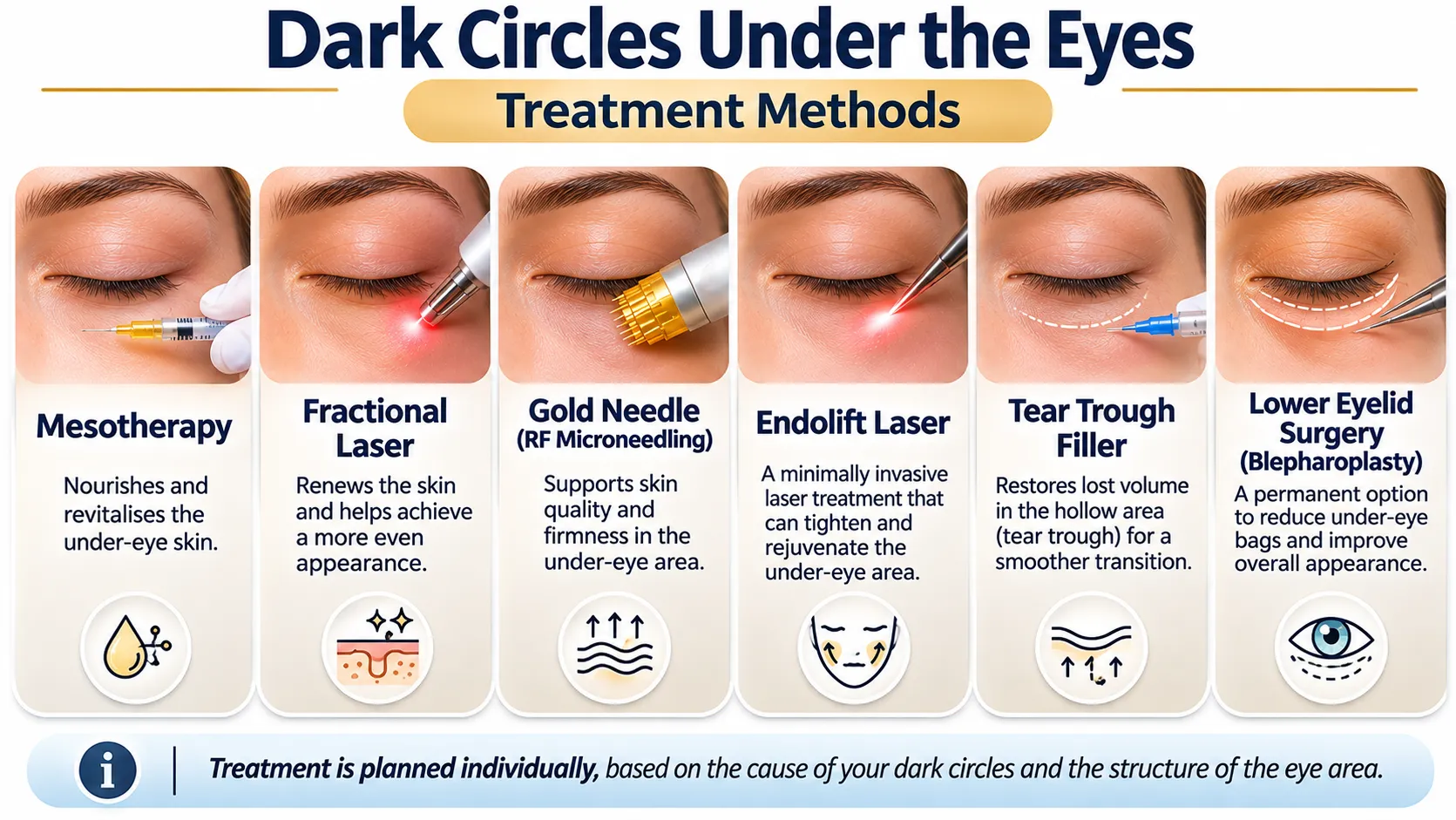
Treatment is planned individually, based on the underlying cause of the dark circles and the structure of the eye area. In people where skin discolouration is the main issue, carbon peeling, mesotherapy and gold needle treatments may be preferred to improve skin quality and appearance. In suitable patients, fractional laser can be used to renew the skin and achieve a more even appearance. Endolift laser and lower eyelid surgery are also among the permanent treatment options.
What Causes Dark Circles Under the Eyes?
Alongside genetic and structural features, iron or certain vitamin deficiencies, smoking, tiredness and skin type can all contribute to darker-looking skin around the eyes. Visible blood vessels and thin skin under the eyes can also make dark circles more noticeable.
Genetic and Structural Causes
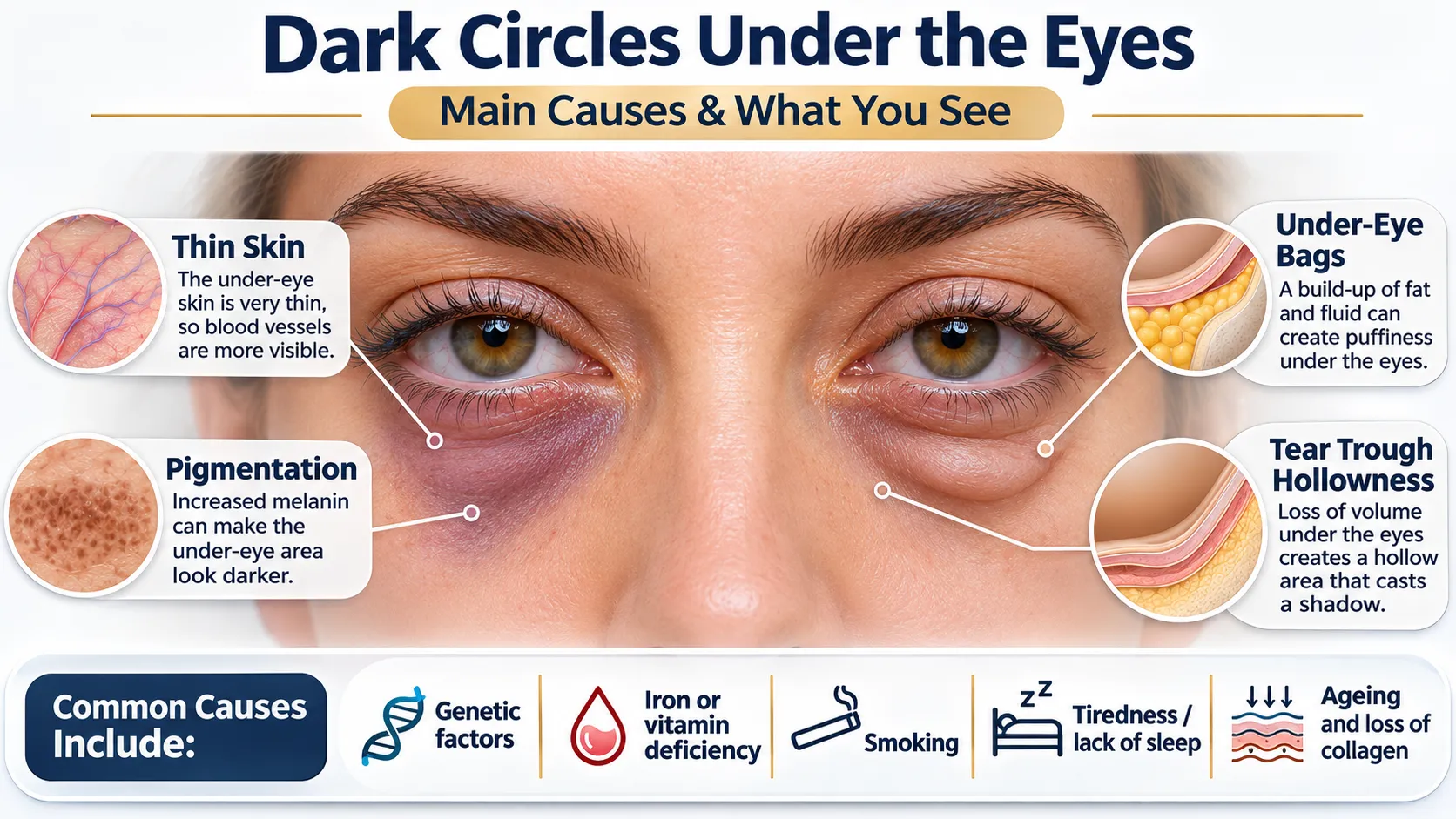
Dark circles under the eyes may be linked to genetic traits inherited from your family.[1] If your mother or father has dark circles, you may have them too. Some people are born with thinner skin around the eyes. As a result, the blood vessels beneath the skin are more visible, creating a purplish colour under the eyes.[2]
The structure of your eyes also affects how dark circles look. If you have deep tear troughs in particular, shadows form in this area. Under-eye bags, caused by a build-up of fat and fluid, can make these shadows worse. Some people also genetically have more melanin – the pigment that gives skin its colour – around the eyes. This can make the under-eye area look darker. These types of dark circles can appear from childhood or adolescence onwards.
Thin Skin and Visible Blood Vessels
The skin under the eyes is one of the thinnest areas of skin on the body. In some people this area is even thinner, so the blood vessels beneath the skin are easy to see. Through the skin, the vessels can look bluish or purplish. This makes it look as though there is a permanent bruise under the eyes.
As we age, the amount of collagen in the skin decreases and the eye area becomes even thinner. Blood vessels that were barely noticeable before can then become more visible. The dark appearance here does not always mean the skin colour has changed. Sometimes it is simply the blood vessels showing through thin skin.
Do Tear Troughs Make Dark Circles Worse?
Yes, hollowness under the eyes changes the way light reflects off the area, which can make dark circles and a tired look more noticeable.
As we age, the fat tissue under the eyes decreases, the skin thins and the cheeks may sag slightly downwards. These changes make the hollows under the eyes more pronounced. If you also have under-eye bags, the contrast between the hollow and the bag becomes even more noticeable. When light hits this area, the shadow it creates makes the under-eye area look purple or dark. So sometimes the darkness you see has less to do with your skin colour and more to do with the hollow structure under your eyes.[1]
In people where this kind of structural hollowness is the main issue, treatments such as tear trough filler may be used to restore lost volume and create a smoother transition around the eyes.
Iron and Vitamin Deficiency
Iron deficiency anaemia can make dark circles under the eyes more noticeable.
With anaemia, the skin becomes paler and the darkness under the eyes stands out more. This is particularly common in women with heavy periods, pregnant women and people who don't get enough iron.
Vitamin B12 deficiency can also cause skin darkening in some people.[3] It is more common in people who don't eat animal products, older people and those with B12 absorption problems. If your dark circles come with tiredness, weakness and paleness, it is important to have blood tests.
Smoking, Tiredness and Lifestyle
Smoking can speed up ageing and collagen loss in the skin around the eyes.[4] As the skin thins, the blood vessels beneath it become more visible and dark circles can worsen. Lack of sleep and constant tiredness can also make the skin look paler, making dark circles stand out. Drinking too much alcohol can dehydrate the body. This can make the hollows and darkness under the eyes more noticeable.
Underlying Health Conditions
Some health conditions can make dark circles under the eyes worse. Nasal congestion caused by allergic rhinitis and sinusitis, in particular, can affect blood circulation around the eyes and create a purplish appearance. Eczema can cause itching and irritation around the eyes, leading to darker skin. Under-eye puffiness, which can occur with kidney and thyroid conditions, can also cast shadows and make dark circles look more pronounced.
So, are dark circles linked to the liver? Yes, liver disease can cause some skin changes, but dark circles on their own are not a typical sign of liver disease. If you have other symptoms alongside your dark circles, it's a good idea to see a doctor.
What Causes Dark Circles Under the Eyes in Children?
In children, dark circles are usually caused by genetics, thin under-eye skin, allergies and nasal congestion.
In children with allergic rhinitis in particular, the blood vessels around the eyes can become more visible. Lack of sleep and tiredness can also make dark circles worse. Sometimes iron deficiency anaemia can also make the darkness more noticeable.
How Do You Get Rid of Dark Circles Under the Eyes?
Getting into a regular sleep routine, using a cold compress, protecting the eye area from the sun and treating any allergies can help with dark circles. If you have an iron or vitamin deficiency, addressing it is also important. For dark circles caused by genetics, skin discolouration or tear troughs, special creams, laser treatments or procedures such as fillers may be considered. If you're wondering how to get rid of dark circles under your eyes, the best approach is to consult a specialist and start the right treatment based on the cause.
What Can You Do at Home?
If you're wondering how to get rid of dark circles at home, a few changes to your daily habits can help. So what should you do for dark circles? Here are some quick tips:
- Aim to sleep 7–9 hours every night.
- Apply a cold compress under your eyes for 5–10 minutes.
- Protect the area around your eyes from the sun and use sunscreen with SPF 30 or higher.
- Drink enough water throughout the day.
- Avoid rubbing your eyes.
- Avoid smoking and excessive alcohol.
- If your under-eyes are puffy in the morning, sleep with your head slightly raised.
These methods can help reduce dark circles caused by tiredness and puffiness in particular. However, they may not completely get rid of dark circles caused by genetics or tear troughs.
When Is Medical Treatment Needed?
Dark circles caused by tear troughs, visible blood vessels or skin discolouration in particular may need laser, filler or other treatments. If your dark circles come with extreme tiredness, weakness or paleness, any underlying health conditions should be investigated thoroughly. If you suddenly develop a dark circle, pain or swelling under one eye, see a doctor without delay!
If your dark circles have lasted a long time, are getting darker or aren't improving with home remedies, it's a good idea to see an aesthetic and plastic surgeon.
How Are Dark Circles Under the Eyes Treated? What Are the Methods?
Depending on the underlying cause of the dark circles and the structure of the eye area, the methods used are carbon peeling, mesotherapy, fractional laser, tear trough filler, Endolift laser and lower eyelid surgery.
Carbon Peeling
Carbon peeling is a skin rejuvenation procedure in which a special carbon-based product is applied to the skin and used together with a laser. It can lighten superficial pigmentation, but its effect on dark circles is limited and it is not routinely used around the eyes.
Mesotherapy and Gold Needle
In mesotherapy, various ingredients are injected around the eyes, while gold needle (RF microneedling) treatment uses very fine needles to stimulate collagen production in the skin. These treatments aim to improve skin quality, but scientific evidence that they get rid of dark circles is limited.
Fractional Laser
Fractional laser creates small, controlled treatment zones in the skin to support collagen production and skin renewal. It can reduce the appearance of dark circles, particularly in cases of thin skin and some types of pigmentation.
Tear Trough Filler
Tear trough filler is a procedure that usually uses hyaluronic acid fillers to fill the hollows under the eyes. By reducing the shadow caused by the hollow, it can make the under-eye area look brighter, but it isn't effective for every type of dark circle.
Endolift Laser
Endolift is a procedure that uses a very thin laser fibre placed under the skin to tighten tissue and support collagen production. It can reduce the appearance of mild sagging and bags under the eyes, but its direct effect on treating dark circles has not yet been sufficiently proven.
Lower Eyelid Surgery (Dark Circle Surgery)
In lower eyelid surgery, excess skin and fat under the eyes can be removed, or fat can be repositioned to fill the hollows. It can make the under-eye area look brighter by reducing shadows caused by bags and hollowness in particular, but it does not directly treat skin discolouration.
Dark Circle Treatment in Ankara: Personalised Planning by Op. Dr. Gözde Erten
Op. Dr. Gözde Erten has for years been creating personalised treatment plans for dark circles in Ankara, based on each patient's skin type, hollows and the cause of their dark circles. If you have dark circles under your eyes, get in touch.
Which Doctor Should You See for Dark Circles Under the Eyes?
For dark circles under the eyes, you can see an aesthetic and plastic surgeon or a dermatologist.
An aesthetic and plastic surgeon may offer better solutions, especially for dark circles caused by tear troughs, bags and skin structure.
Dark Circle Treatment Prices in Ankara
In 2026, dark circle treatment prices in Ankara can range from approximately £50 to £2,000, depending on the method used.
Non-surgical treatments are usually less expensive, while surgical procedures cost more. To get an exact price, you need an examination so the real cause of the problem can be identified. Not every case of dark circles can be treated with the same method.
Factors Affecting the Price of Dark Circle Treatment
Dark circle treatment prices in Ankara vary depending on the method used and the condition of your under-eye area. The price is mainly affected by the cause of the dark circles, the chosen method, the number of sessions and the scope of the procedure. For some people a single treatment may be enough, while others may need several sessions or a combination of different treatments.
Do Dark Circles Under the Eyes Go Away Completely?
Yes, some dark circles can go away completely with treatment suited to their cause. Dark circles caused by allergies, tiredness or temporary skin problems in particular can improve. However, there is no guarantee that dark circles caused by genetic and structural factors will disappear completely.
Because the cause of dark circles varies from person to person, the treatment approach also differs. In people with genetic and structural factors in particular, the aim is to reduce the appearance of dark circles and help the eye area look brighter, more rested and more even.
As the under-eye area is a delicate anatomical region, your doctor should plan a solution specific to your problem by assessing the structure of the eye area and the cause of the dark circles.
Is There a Definitive Solution for Genetic Dark Circles?
There is no definitive solution for genetic dark circles that works for everyone. However, depending on the cause, the darkness can be significantly reduced with laser, tear trough filler or surgical procedures.
Frequently Asked Questions
Vitamin B12 deficiency can make dark circles more noticeable by causing anaemia, paleness or changes in skin colour.
Yes, lack of sleep can make your skin look paler, making the blood vessels and existing dark circles under your eyes more noticeable.
No, dark circles are a darker appearance of the skin around the eyes, while under-eye bags are swelling in this area that can make dark circles look more pronounced because of the shadow they cast.
Yes, one session may be enough for some dark circles. However, depending on the cause and the treatment used, you may need several sessions.
You can start by seeing a paediatrician. If the dark circles are caused by the structure of the under-eye area, your doctor may refer you to an aesthetic and plastic surgeon.
Bothered by dark circles under your eyes? Book a consultation at our clinic in Ankara and we'll find the cause and the right treatment together.
Sources
- Sarkar R, et al. Periorbital Hyperpigmentation: A Comprehensive Review. Journal of Clinical and Aesthetic Dermatology. 2016;9(1):49–55.
- Park KY, et al. Treatments of Infra-Orbital Dark Circles by Various Etiologies. Annals of Dermatology. 2018;30(5):522–528.
- Mendiratta V, et al. Study of Causative Factors and Clinical Patterns of Periorbital Pigmentation. Indian Dermatology Online Journal. 2019;10(3):293–295.
- Morita A. Tobacco smoke causes premature skin aging. Journal of Dermatological Science. 2007;48(3):169–175.
This article is for general information only and doesn't replace a medical consultation. Suitability and results vary from person to person.
Author: Op. Dr. Gözde Erten, Plastic, Reconstructive and Aesthetic Surgery Specialist. Last updated: .