

Fractional laser treatment may reduce the appearance of stretch marks, but it cannot remove them completely. Results and recovery vary with the type of stretch marks, skin tone and treatment settings. At her clinic in Çankaya, Ankara, Op. Dr. Gözde Erten assesses suitability and discusses treatment options and realistic expectations.
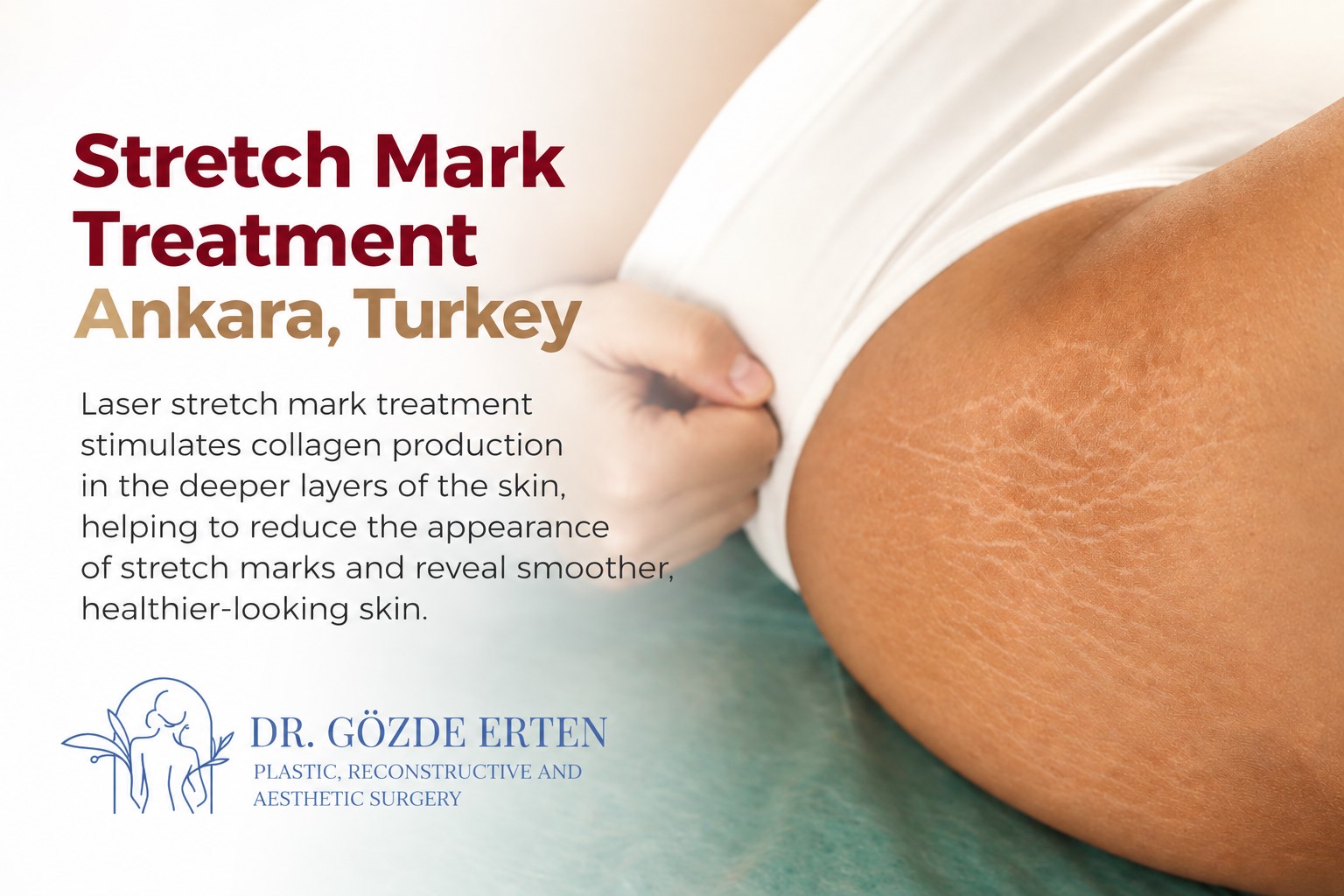
Stretch marks (striae distensae) are scars that can develop when skin stretches or shrinks rapidly, for example during pregnancy, adolescence or weight changes. They may initially look red, purple or brown before becoming paler over time. Their appearance also depends on skin tone. [1]
| Treatment goal | Partial improvement in texture and visibility; complete removal is not expected. |
|---|---|
| Sessions | A course of treatments may be needed. The number and spacing are decided after examination and reassessed as the skin heals. |
| Recovery | Redness, swelling and crusting may occur. Downtime depends on the device, settings, area and individual healing. |
| Risks | Pigment changes, infection and scarring; darker skin tones need particular consideration. |
| Cost | Assessed individually according to the treated area, device and proposed course. |
What is laser stretch mark treatment and how does it work?
Fractional lasers treat tiny areas of skin to stimulate its repair process and the formation of collagen, a protein that supports skin structure. This can help improve the texture of stretch marks. Some topical treatments may also help make early stretch marks less noticeable. [1] [2]
Fractional laser technology for stretch marks
Fractional CO₂ laser creates tiny treatment channels in the skin, leaving areas between them untreated to support healing. Other fractional lasers heat the skin without removing its surface. These approaches differ in their recovery time and risks. Your doctor selects a device according to your skin tone, the type of stretch marks and the recovery time you can allow. [2]
The assessment also considers whether the marks are still red or purple or have developed into older, pale lines, as this helps guide the treatment approach.
For an overview of other procedures, explore our laser treatments in Ankara. If your concern is a surgical or injury scar, see laser scar treatment; for marks left by acne, see laser acne scar treatment.
If loose skin is also a concern, see laser skin tightening. The suitability of that treatment needs a separate assessment.
Which areas of the body can be assessed?
Stretch marks on the abdomen, thighs, hips, upper arms, chest and back can be assessed. Treatment suitability and settings depend on the location, skin condition and healing history. Where abdominal stretch marks accompany excess skin, a mini tummy tuck may be discussed for suitable patients; it is a different procedure with different risks.
If you are also considering changes to body shape, our body contouring procedures page provides an overview of the available surgical options.
Laser treatment for stretch marks after pregnancy
Pregnancy-related stretch marks can become less noticeable naturally over time. Laser treatment may be considered after an individual assessment; there is no universal start date after childbirth. Tell your doctor if you are breastfeeding so that the proposed procedure, anaesthetic and aftercare products can be assessed. [1]
If localised fat is also a concern after pregnancy, liposuction addresses that concern separately and does not itself treat stretch marks.
What to expect during and after treatment
- Discomfort: A numbing cream may be used to make treatment more comfortable, although you may still feel heat or stinging.
- Results: Changes develop as the skin repairs itself. Follow-up appointments help assess progress and guide further treatment.
- Recovery: Redness, swelling and crusting can occur. The extent and duration depend on the treatment and individual healing. Follow the prescribed cleansing, moisturising and sun-protection instructions. [2]
Who needs extra assessment, and what are the risks?
Discuss your skin tone, recent tanning, medical conditions, medicines, previous healing problems and any active skin infection with your doctor. Post-inflammatory hyperpigmentation is an important consideration, particularly in darker skin tones. Other possible complications include lighter patches, infection and scarring. Appropriate settings and aftercare reduce risks but do not eliminate them. [2] [3]
Protect the treated skin from sunlight and do not pick crusts. Ask the clinic when you can resume exercise, swimming and your usual skin products. Contact your treating clinician if redness or pain worsens, or if you develop discharge or fever.
How many sessions are needed?
A treatment plan starts with examination of the marks, skin type, treatment area and medical history. Your doctor adjusts the treatment strength and the proportion of skin treated during each session, and explains numbing options and aftercare.
Several sessions may be proposed, with time between them for healing and reassessment. A clinical trial studied three sessions at four-week intervals, but a study protocol is not a prescription for every patient. The appropriate course and whether to continue depend on response and tolerability. [2]
Additional procedures should only be considered after discussing their specific evidence, risks and likely benefit. Combination treatment is not required for everyone.
Laser stretch mark treatment cost in Ankara, Turkey
The cost is assessed individually according to the size and number of areas, the selected device, the proposed sessions and any additional procedures. Ask whether the quotation covers consultation, aftercare and follow-up, and whether it is per session or for a course.
For a personalised assessment and cost information, contact the clinic in Çankaya, Ankara.
Planning treatment when travelling to Ankara
Before booking travel, discuss whether an in-person assessment is needed before treatment, the expected recovery period and when follow-up should take place. Ask how concerns will be handled after you return home. The required length of stay and timing of further sessions depend on your treatment plan; a single visit may not complete a course.
Frequently Asked Questions About Laser Stretch Mark Treatment
Laser treatment may reduce the visibility and improve the texture of stretch marks, but it cannot remove them completely. The degree of improvement varies with the age and type of the marks, skin tone, device and treatment settings. A specific percentage of improvement cannot be guaranteed.
Improvement may persist, but its degree and duration vary. Laser treatment does not prevent new stretch marks, and pregnancy, weight changes and ageing can alter the appearance of the skin. Long-term results cannot be guaranteed.
Laser treatment can cause redness, swelling, discomfort and crusting. Pigment changes, infection and scarring are also possible. Post-inflammatory hyperpigmentation is a particular concern in darker skin tones. Your doctor should assess these risks and explain suitable settings and aftercare before treatment.
Treatment timing depends on sun exposure, tanning and the ability to follow aftercare. Treated skin needs protection from sunlight, and treatment may need to be postponed after tanning or when sun exposure cannot be avoided. Covering the area does not eliminate the risk of pigment changes.
Fractional laser may improve the texture and visibility of stretch marks after pregnancy by stimulating skin remodelling. Timing is individual: tell your doctor if you are breastfeeding so that treatment, anaesthetic and aftercare products can be assessed. There is no single start date or guaranteed success rate for everyone.
Discuss your treatment options
To discuss suitability and arrange a consultation with Op. Dr. Gözde Erten in Çankaya, Ankara, contact the clinic or send an enquiry via WhatsApp.
Sources
- American Academy of Dermatology: Stretch marks — why they appear and how to get rid of them.
- Treatment of Striae Distensae with Nonablative Fractional Laser versus Ablative CO₂ Fractional Laser: A Randomized Controlled Trial. 2011.
- Fractional Carbon Dioxide Laser Versus Carboxytherapy in Treatment of Striae Distensae. 2021.
The content on this page is for informational purposes only and does not constitute medical advice. For a definitive diagnosis and treatment plan, you can contact Op. Dr. Gözde Erten.
Author: Op. Dr. Gözde Erten, Plastic, Reconstructive and Aesthetic Surgery Specialist. Last updated: .